Guided vs non-guided health insurance: choice, access and cost
Guided cover changes how you reach a specialist. Before choosing it, check whether the referral route fits the way you want to use your insurance.
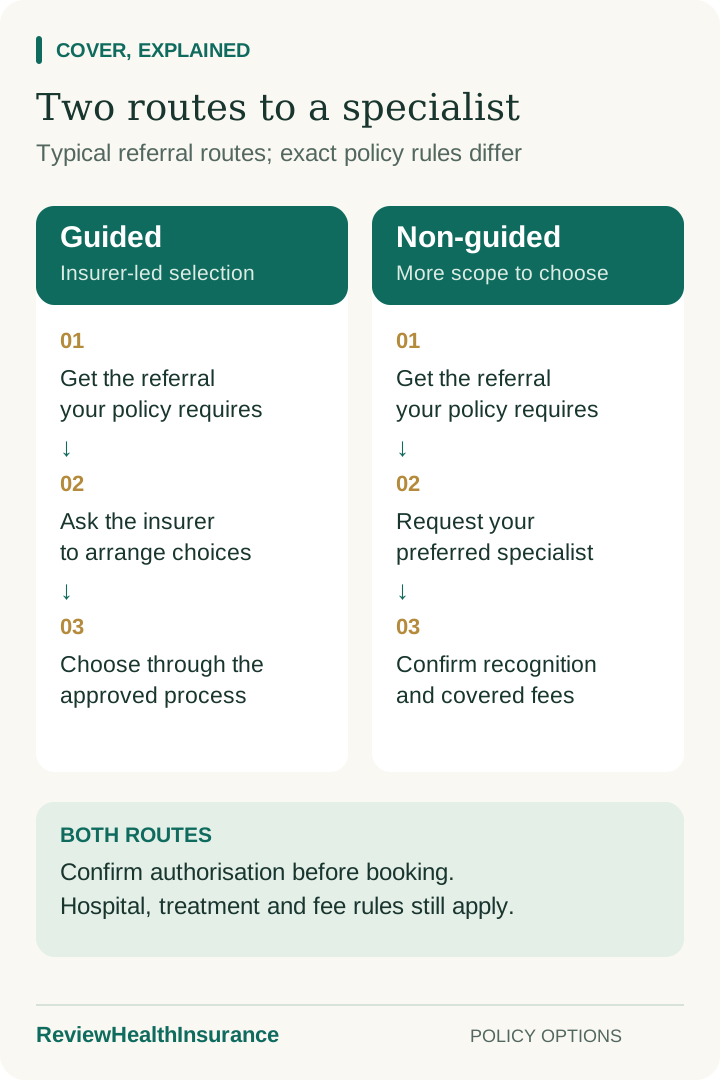
Guided health insurance means following your insurer’s process to find a suitable specialist. Non-guided cover usually gives you more freedom to request a particular consultant, provided they meet the insurer’s requirements.
Both can provide access to private healthcare. The difference is how you arrange that care and which providers your policy will pay.
Before choosing, compare the referral rules, hospital access, level of cover and premiums. A lower price may be attractive, but you need to be comfortable with the consultant choices available.
What is guided health insurance?
With guided private health insurance, the insurer sources a specialist or offers a shortlist based on your referral and treatment needs.
You normally contact the insurer before booking consultations. It checks your eligibility and explains which consultants or facilities you can use.
Guided cover may suit someone who wants help finding a private specialist and does not have a particular consultant in mind.
However, do not assume every guided scheme works in the same way. Some use your selected hospital network; others identify suitable facilities when you claim.
What is non-guided health insurance?
Non-guided private medical insurance usually allows more choice of named consultant.
That does not mean you can book any doctor at any hospital and expect the insurer to pay. The consultant must meet the insurer’s recognition requirements, the treatment must be eligible and the location must be allowed under your policy.
Fees also matter. Your preferred consultant may charge more than the insurer will reimburse, leaving you with a shortfall.
You can still ask your insurer to help find a consultant on a non-guided plan. Using that service does not, by itself, change your policy into guided cover.
Guided and non-guided cover compared
| What to compare | Guided cover | Non-guided cover |
|---|---|---|
| Consultant selection | Follow the insurer’s selection process or choose from its shortlist. | Usually more scope to request a named consultant the insurer recognises. |
| Referral | An open referral is commonly required, with exceptions depending on the policy. | Named or open referrals may be accepted, depending on the insurer. |
| Hospital access | May depend on your selected network or the options offered when you claim. | Still subject to the hospital option and treatment approval. |
| Consultant fees | Approved providers may have agreed fees, but excesses and benefit limits still apply. | Check whether your chosen consultant’s fees are covered in full. |
| Cost | May offer lower premiums in exchange for restrictions on provider choice. | Greater choice may cost more; compare otherwise equivalent quotes. |
| Approval | Contact the insurer before booking. | Contact the insurer before booking. |
The policy documents determine the actual rules. These are general differences, not a promise about every private medical insurance product.
What is an open referral?
An open referral identifies the type of specialist you need rather than naming a particular doctor.
For example, a GP referral might request an orthopaedic assessment without specifying the consultant. The insurer can then use that information to find suitable options.
A referral explains the clinical reason for consultations or treatment. It does not confirm that the insurer will pay.
An open referral is also not exclusive to guided insurance. Insurers may use it to help members with other policy options find care.
Before asking your GP for a letter, check what your insurer requires. This can avoid needing a replacement referral.
How do the insurers’ guided options differ?
AXA Health: Guided and Foundation
AXA’s published specialist guide says it must source the specialist for members with its Guided or Foundation option.
Without those options, members can choose a specialist AXA works with or ask it to find one.
Its guide warns that using a specialist it has not sourced under a guided arrangement can leave you paying some or all of the treatment costs. Contact the insurer before arranging consultations.
Bupa: Guided Care
Bupa’s Guided Care leaflet describes a choice of two or three consultants from its Open Referral Network, at facilities within your chosen hospital network.
The leaflet says approved consultant fees are covered, but your policy excess and outpatient benefit allowances still apply.
It also states that Guided Care is not available for anyone under 18. If you are comparing family health insurance, ask how children’s referrals and consultant selection work under the quoted policy.
Aviva: Expert Select
Aviva’s Expert Select option offers facilities based on the treatment you need. The available choices may therefore differ between claims.
Its published guidance says you cannot choose a specialist outside the Expert Select list.
Aviva also generally asks for an open referral under its other hospital options. This is another reason not to treat “open referral” and “guided insurance” as interchangeable terms.
Vitality: Consultant Select
Vitality describes Consultant Select as access to a selected panel of consultants.
Its hospital-options page says that, with Consultant Select, it will only pay for treatment authorised in advance. Confirm the consultant, location and planned care before booking.
The Exeter: guided option
The Exeter says its guided option uses an open GP referral to recommend a shortlist of suitable specialists.
You do not choose a hospital list when taking out its guided policy. Ask how the available locations would work for your circumstances, especially if you want to use a particular hospital.
Does guided cover mean fewer benefits?
The referral option alone does not tell you the level of cover.
When comparing private health insurance, check consultant choice separately from the benefits that pay for consultations, tests and treatment.
Ask about:
- Initial and follow-up consultations.
- Diagnostic tests, including MRI and CT scans.
- In-patient treatment and hospital stays.
- Day-patient treatment.
- Physiotherapy and other therapies.
- Cancer cover.
- Mental health cover.
A guided policy with a broad range of benefits may provide more useful cover for your needs than a non-guided policy with a low consultation allowance.
Equally, broad benefits may not meet your priorities if you cannot use a consultant you specifically want.
Compare the whole private medical insurance policy, not just the guided or non-guided label.
Check consultations, tests and outpatient limits
Consultations and investigations can be an important part of reaching a diagnosis before hospital treatment is considered.
Depending on the product, outpatient benefits may have a monetary allowance, a limit on consultations or separate rules for diagnostic tests and scans.
A policy might approve your consultant but still leave you paying after you have used the relevant allowance. Follow-up consultations can also count towards a limit.
Ask whether physiotherapy shares that allowance or has separate session limits. Other therapies, such as osteopathy or chiropractic treatment, may have their own referral and provider requirements.
Our outpatient cover guide explains how these limits can differ.
Does every claim need a GP referral?
No. Some policies offer direct access services for specified symptoms or treatment needs.
For example, Bupa describes routes for cancer concerns, mental health symptoms and muscle, bone or joint problems that may avoid an initial GP referral, depending on the policy and symptoms.
Direct access does not mean you can arrange any private healthcare appointment yourself. Follow the insurer’s service and approval process.
If you need physiotherapy, ask whether you should start through a telephone or online assessment, obtain a GP referral or contact an approved therapist.
Also distinguish general mental health support from insured mental health treatment. Ask which service you are using and what benefits or limits apply.
What are shortfalls, and how can you avoid them?
A fee shortfall is the difference between a provider’s charge and the amount the insurer agrees to pay.
Shortfalls can arise even where an insurer recognises the consultant. Recognition and full reimbursement are separate checks.
For example, suppose a consultant charges £250 for a consultation and the policy pays £200. You would have a £50 fee shortfall, before considering any excess. This is a hypothetical calculation, not an insurer’s fee schedule.
Before booking consultations or procedures, ask:
- Is this consultant approved for my referral option?
- Will their consultation and treatment fees be covered in full?
- Are the hospital and anaesthetist covered separately?
- Could benefit limits leave an amount unpaid?
- What would I pay if I chose another consultant?
Approved guided arrangements can reduce the risk of consultant fee shortfalls through agreed fees. They do not remove every possible personal cost.
Your excess is different from a fee shortfall: it is the contribution specified by your policy. Using up a benefit allowance is another separate reason you might receive a bill.
Ask for confirmation of all three. Our health insurance excess guide explains the contribution you choose.
Your hospital list is a separate check
Ask two questions:
- Is this hospital available under my policy?
- Can I see this consultant there under my referral option?
A “yes” to the first does not settle the second.
One course of private healthcare may involve consultations at a clinic, scans at a diagnostic centre and surgery elsewhere. Give the insurer the exact location for each stage.
Our hospital-list guide explains how to check facilities and avoid confusing a directory entry with approval for treatment.
Does guided insurance mean shorter waiting times?
Do not assume guided cover guarantees shorter waiting times than non-guided cover.
Ask about the actual appointments available for the relevant specialty and location. The most useful comparison is between suitable consultants you can realistically see.
Consider the whole treatment journey:
- How soon is the first consultation?
- Where would diagnostic tests take place?
- How soon could follow-up consultations happen?
- If treatment is needed, where would it be arranged?
A quick first appointment does not answer every question about later care. Our guide to NHS and private waiting times explains the wider considerations.
How does private medical insurance work alongside the NHS?
Private medical insurance, often shortened to PMI, can provide another route to eligible consultations and treatment. It does not replace the National Health Service.
Choosing guided or non-guided private health insurance does not remove your access to NHS care.
You may continue using the NHS for services outside your policy, excluded conditions or care you prefer to receive through the NHS. Standard PMI is not a substitute for NHS emergency care.
Being on NHS waiting lists also does not, by itself, make treatment eligible under a new policy. Symptoms or conditions that began before cover started may be excluded.
If you are already waiting for investigations or treatment, explain this when applying. Do not assume buying private medical insurance will fund that existing problem.
Does guided cover change how pre-existing conditions are treated?
Guided cover concerns provider selection. Underwriting concerns how your medical history affects cover.
Choosing non-guided PMI does not automatically give you cover for pre-existing conditions. Choosing guided PMI does not remove the need to check exclusions.
Full medical underwriting
With full medical underwriting, or FMU, you answer medical-history questions before the policy starts. The insurer assesses that information and confirms the terms offered.
Read any exclusions before accepting the policy. Full medical underwriting does not mean every condition you disclose will be covered.
Moratorium underwriting
With moratorium underwriting, there is usually less medical-history information to provide at the outset. The insurer may investigate your history when you claim.
Pre-existing conditions are excluded according to the policy’s moratorium rules. Some may become eligible later if the required conditions are met.
Moratorium underwriting does not mean every exclusion disappears automatically after a set number of years. Check the relevant period and the rules about symptoms, treatment, medication and medical advice.
Switching an existing policy
If you already have private medical insurance, ask which underwriting options are available for a switch and how existing exclusions or ongoing treatment would be handled.
Compare the acceptance terms alongside consultant choice. Do not cancel existing cover before the replacement insurer has confirmed its terms.
Our switching with pre-existing conditions guide explains the checks.
What about acute and chronic conditions?
Private health insurance generally focuses on eligible acute conditions: illnesses or injuries expected to respond to treatment.
The ongoing management of chronic conditions is commonly restricted. These can include conditions requiring long-term monitoring, control or relief.
The exact rules matter. A policy may treat an unexpected flare-up differently from routine ongoing care. Cancer care also has specific terms and should be checked separately.
Guided or non-guided access does not override these benefit rules. Nor does it make normally excluded treatment, such as cosmetic surgery performed solely to improve appearance, eligible.
Compare the annual difference in premiums
Ask for guided and non-guided quotes with the same other benefits and underwriting basis.
For illustration, a monthly premium of £95 for guided cover and £110 for non-guided cover produces:
- Guided: £1,140 over twelve monthly payments.
- Non-guided: £1,320 over twelve monthly payments.
- Difference: £180 a year.
These are hypothetical figures, not private medical insurance quotations.
The question is whether the additional consultant choice is worth £180 a year to you.
Check that the level of cover matches. If the consultation allowance, hospital access or excess also changes, the difference in premiums is not solely the cost of consultant choice.
Compare future affordability too. Ask how claims affect any no-claims discount and how renewal premiums are calculated. The referral option alone does not tell you the no-claims discount rules.
Our no-claims discount guide explains why the discount percentage is only part of the price.
Can you self-pay for a consultant outside the guided options?
You can ask a provider about self-pay consultations, but do not assume your PMI policy will reimburse them.
Before doing so, ask the insurer whether a consultation outside its process would affect authorisation for any later tests or treatment.
Also ask the provider for a written estimate. A self-pay consultation price may exclude scans, procedures and follow-up consultations.
If you intend to return to insured care afterwards, get the insurer’s requirements in writing first.
Which option is more suitable for you?
Guided private health insurance may suit you if:
- You want help finding an appropriate specialist.
- You are comfortable choosing from the insurer’s options.
- The likely locations are practical for you.
- The quoted saving is worthwhile with the same level of cover.
Non-guided private health insurance may suit you if:
- You value greater freedom to request a named consultant.
- You have a particular specialist in mind.
- You are willing to check recognition, fees and potential shortfalls.
- The additional premiums are affordable.
For family health insurance, check the process for children separately. For existing treatment, ask about continuity before changing your referral option.
A health insurance broker can help compare the policy terms, consultant restrictions and costs. Give them your priorities rather than asking only for the cheapest PMI quote.
Questions to ask before accepting a quote
- Does my policy require an open referral?
- Who finds the consultant and books consultations?
- Can I request a named specialist?
- What happens if there is no suitable local option?
- Which facilities could I use for tests and treatment?
- Are approved consultant fees paid in full?
- Could I face shortfalls, an excess or exhausted benefit limits?
- How do referrals work for physiotherapy and other therapies?
- Do children follow different rules?
- What happens to current treatment if I change my cover?
Keep the answers with your quotation and policy documents.
Common questions
Is an open referral the same as guided insurance?
No. It describes the referral letter rather than the policy. Both guided and other private medical insurance options may use an open referral.
Does non-guided cover mean I can see any consultant?
No. The insurer must recognise the consultant, and the treatment, fees and location must meet your policy terms.
Are guided consultants less qualified?
The guided label does not establish that. It describes how consultants are selected under the policy. Ask about the proposed specialist’s experience and suitability for your condition.
Can I still use the NHS?
Yes. Private medical insurance provides an additional route for eligible care. You can continue to use NHS services.
Does guided cover remove all shortfalls?
No. Approved consultant arrangements may address fee shortfalls, but excesses, benefit limits and excluded care can still leave costs for you to pay.
Can I change from guided to non-guided later?
Ask your insurer when changes are permitted and what conditions apply. Do not assume you can change midway through the year or use a wider option immediately for existing treatment.
Sources and policy scope
Sources checked on 8 October 2026. This guide compares published approaches, not every product version. Your quotation, membership certificate and policy wording determine your cover.
- AXA: choosing a specialist
- Bupa: Guided Care customer leaflet
- Bupa: referring an insured patient and direct access
- Aviva: hospital options and Expert Select
- Vitality: consultant and hospital options
- The Exeter: health insurance and guided cover
- Bupa: medical underwriting
- Bupa: moratorium explained
- Bupa: pre-existing conditions
- AXA: outpatient treatment and limits
- AXA: chronic conditions explained
- MoneyHelper: private medical insurance
The information provided on this website is for general information purposes only and does not constitute advice. Insurance options may vary depending on individual circumstances.